


Meet the New PTM Series: PTM-10 Gen 2 & PTM-20
Phenyx Pro upgrades the PTM Series with the PTM-10 Gen 2, featuring Auto Scan and adjustable RF power, and the dual-channel PTM-20 for two independent stereo monitor feeds.

Two New Systems. One Powerful Platform. Your Monitoring Evolved.
Today, we're proud to introduce two new additions to the Phenyx Pro PTM Series:
PTM-10 Gen 2 – the upgraded evolution of our PTM-10 stereo wireless in-ear monitor system, refined around real-world monitoring workflows.
PTM-20 – a brand-new dual-channel system that carries two independent stereo monitor feeds from the mixer through one compact transmitter unit.
Together, they represent the next step in Phenyx Pro wireless in-ear monitoring – with faster frequency setup and more flexibility for different monitoring workflows.
But before we dive into what makes these new systems different, let's take a step back and look at how the PTM Series has evolved.
Why We Built the PTM Series
At Phenyx Pro, our in-house engineering and product teams stay closely connected with users, continuously refining our audio products around real-world performance needs.
For wireless monitoring, two practical challenges kept coming up.
1. RF conditions change from stage to stage.
Manually stepping through frequencies can take valuable time during setup, especially when the wireless environment becomes more crowded.
2. Different stages need different monitoring workflows.
Some performers only need one dependable stereo monitor feed, while others need separate monitor feeds for performers with different listening priorities.
So we kept coming back to one simple question:
How can we make wireless monitoring easier to set up while giving performers the flexibility to choose the workflow that actually fits their stage?
That idea helped shape the PTM Series – wireless in-ear monitoring systems designed around practical stage workflows, not just feature lists.
The original PTM-10 became a key model in our Stereo Monitoring Series, combining stereo monitoring with practical controls for stage and rehearsal use.
As we continued listening to performers and users, we saw opportunities to make the setup experience more efficient while expanding the monitoring options available within the PTM family.
Now, in 2026, we're introducing two new systems that take that idea forward.
PTM-10 Gen 2: The Upgraded Evolution of a Stage Favorite
The PTM-10 Gen 2 is the direct successor to the original PTM-10.
It retains the core monitoring workflow that defined the first generation – stereo monitoring, flexible Mono/Stereo operation, and practical onboard controls – while updating several areas of the system for a more flexible setup experience.

What Stayed the Same
Several of the practical features found on the original PTM-10 continue into the Gen 2 monitoring workflow:
- Stereo monitoring for a defined left/right listening image when the source feed is stereo.
- PAD control to attenuate stronger input signals and help prevent input overload.
- Mono/Stereo selection for different monitoring sources and workflows.
- Balance, EQ, limiter, and lock controls for practical listening and setup adjustments.
- IR synchronization for frequency matching between the transmitter and receiver.
- A rack-ready design suited to stage, rehearsal, and installed monitoring setups.
The core idea remains the same: give the performer a practical wireless path from the mixer to their in-ears without unnecessary complexity.

What's New: PTM-10 vs. PTM-10 Gen 2
| Feature | PTM-10 Original | PTM-10 Gen 2 | What This Means for You |
|---|---|---|---|
| Frequency Setup | Manual frequency selection with IR sync | Auto Scan with frequency synchronization | Helps reduce manual frequency searching during setup by locating clearer available frequency options more efficiently. |
| RF Transmit Power | Fixed 10 dBm output | 3 selectable RF power levels, up to 30 mW | Provides more flexibility for different stage sizes, operating distances, and RF conditions. |
| Frequency Response | 60 Hz–16 kHz | 50 Hz–18 kHz ±3 dB | Extends the rated frequency-response range at both the low and high ends. |
| Frequency Plan | 500 MHz and 900 MHz versions, with 89 selectable frequencies per version | 555–575 MHz with 63 selectable frequencies | Gen 2 uses a revised frequency plan designed around its updated RF platform. |
The Biggest Upgrades at a Glance
- 1. Auto Scan – Instead of manually stepping through frequencies, Gen 2 helps locate clearer available frequency options automatically, reducing frequency setup guesswork.
- 2. Adjustable RF Power – Three selectable RF power levels, up to 30 mW, provide more flexibility for different operating distances and wireless conditions.
- 3. Wider Rated Frequency Response – The specified response expands from 60 Hz–16 kHz on the original PTM-10 to 50 Hz–18 kHz ±3 dB on Gen 2.
- 4. More Defined Performance Specifications – Gen 2 provides published SNR, THD, and audio-output specifications, giving users a clearer technical reference for system performance.
Rather than changing what the PTM-10 fundamentally is, Gen 2 focuses on making the same one-feed stereo monitoring workflow easier to set up and more flexible to manage.
PTM-10 Gen 2 Specifications
| Parameter | Specification |
|---|---|
| Carrier Frequency | 555–575 MHz |
| Selectable Frequencies | 63 |
| RF Transmit Power | 3 selectable levels, up to 30 mW |
| Max Input Level | 6 dBV |
| Input Impedance | 6.8 kΩ |
| Frequency Response | 50 Hz–18 kHz ±3 dB |
| Stereo Separation | >40 dB |
| Signal-to-Noise Ratio | ≥88 dB (A-weighted) |
| Total Harmonic Distortion | <1% |
| Max Audio Output Power | 70 mW (1 kHz @ <1% THD @ 32Ω) |
| Ideal Operating Distance | 50 m |
PTM-20: Dual-Channel Independence for Bands and Teams
While the PTM-10 Gen 2 continues the one-feed stereo monitoring workflow of the original PTM-10, we also wanted to address a different stage need:
What happens when two performers—or two monitor groups—need different monitor feeds?
That's where the PTM-20 comes in.
The PTM-20 is a brand-new addition to the PTM Series designed around a dual-feed monitoring workflow.
Sharing many of the same core RF and monitoring features as the PTM-10 Gen 2 – including Auto Scan, adjustable RF power, and practical monitoring controls – the PTM-20 adds one important capability:
Two independent stereo monitor feeds carried through a single transmitter unit.

What PTM-20 Brings to the Stage
| Feature | PTM-20 |
|---|---|
| Core Architecture | Dual-channel stereo monitoring with two independent monitor feeds from the mixer |
| Auto Scan | Helps identify clearer available frequency options and reduce manual frequency searching |
| RF Power Control | 3 selectable levels, up to 30 mW |
| Frequency Response | 50 Hz–18 kHz ±3 dB |
| Stereo Separation | >40 dB |
| Signal-to-Noise Ratio | ≥88 dB (A-weighted) |
| Total Harmonic Distortion | <1% |
| Max Audio Output | 70 mW (1 kHz @ <1% THD @ 32Ω) |
| Monitoring Controls | <1% |
| Key Workflow | Mixer Mix A → Channel A; Mixer Mix B → Channel B |

How PTM-20 Works
The important thing to understand about the PTM-20 is where the two monitor mixes come from.
The PTM-20 does not create the performers' mixes itself.
Instead, the two mixes are created independently at the mixer and routed into the PTM-20 as two separate monitor feeds.
The signal path looks like this:
Mixer Mix A → PTM-20 Channel A → Bodypack Receiver → Performer A
Mixer Mix B → PTM-20 Channel B → Bodypack Receiver → Performer B
For example:
- A vocalist might receive a monitor feed that emphasizes vocals, piano, and selected accompaniment through Channel A.
- A drummer might receive a different feed centered around click, bass, and rhythm cues through Channel B.
Each performer can then use the available bodypack controls to adjust their listening experience, while the actual monitor mix remains created upstream at the mixer.
That makes the PTM-20 a natural fit for situations where one shared monitor feed is no longer enough.

PTM-20 Specifications
| Parameter | Specification |
|---|---|
| Carrier Frequency | 555–575 MHz |
| Selectable Frequencies | 63 shared across Channels A and B |
| RF Transmit Power | 3 selectable levels, up to 30 mW |
| Max Input Level | 6 dBV |
| Input Impedance | 6.8 kΩ |
| Frequency Response | 50 Hz–18 kHz ±3 dB |
| Stereo Separation | >40 dB |
| Signal-to-Noise Ratio | ≥88 dB (A-weighted) |
| Total Harmonic Distortion | <1% |
| Max Audio Output Power | 70 mW (1 kHz @ <1% THD @ 32Ω) |
| Ideal Operating Distance | 50 m |
| Key Difference | Dual-channel stereo monitoring with two independent monitor feeds |
Frequency note: Channels A and B share the same pool of 63 selectable frequencies. This should not be interpreted as 63 frequencies per channel.
Shared Core Features Across Both New Systems
Although the PTM-10 Gen 2 and PTM-20 are built around different monitoring workflows, they share a practical set of tools for stage and rehearsal use.
| Feature | Benefit |
|---|---|
| Auto Scan | Helps identify clearer available frequency options and reduce manual frequency searching |
| 3-Level RF Power | Provides selectable transmit power for different operating distances and RF conditions |
| Limiter | Helps control sudden signal peaks during monitoring |
| PAD | Provides input attenuation for stronger source signals |
| Balance | Adjusts perceived level balance within the monitoring workflow |
| EQ | Shapes the performer's listening experience |
| Lock | Helps prevent accidental setting changes during use |
| Mono/Stereo Switching | Supports either a simpler summed monitor feed or a wider left/right monitoring image when the source feed is stereo |
| IR Sync | Supports frequency synchronization between transmitter and receiver |
Both systems are designed to work as part of the larger monitoring signal chain.
The mixer creates the monitor mix. The PTM transmitter carries that feed wirelessly. The bodypack receiver gives the performer practical control over their listening experience.
The mixer creates the monitor mix. The PTM transmitter carries that feed wirelessly. The bodypack receiver gives the performer practical control over their listening experience.
Which New PTM Series System Is Right for You?
The biggest difference between these two systems isn't simply the size of the band or venue.
It's the number of independent monitor feeds your stage actually needs.
Choose PTM-10 Gen 2 if:
- You are a solo performer, vocalist, instrumentalist, or host.
- You use one dedicated monitor feed from your mixer.
- You are part of a small group where multiple performers can share the same monitor feed.
- You want Auto Scan and adjustable RF power within a straightforward one-feed stereo monitoring workflow.
- You are looking for the next-generation evolution of the original PTM-10.
Typical Use Cases: Solo artists, singer-songwriters, vocalists, guitarists, keyboardists, drummers, rehearsal rooms, small stages, worship performers, and live gigs using a shared monitor feed.
Choose PTM-20 if:
- You have two performers with different monitoring needs.
- You are working with two monitor groups that need separate feeds from the mixer.
- A vocalist needs a vocal-focused mix while a drummer needs a click-and-rhythm-focused mix.
- You want to carry two independent stereo monitor feeds through one transmitter unit.
- Your stage needs more routing flexibility than a single-feed monitoring system provides.
Typical Use Cases: Vocal/instrumental duos, worship teams, small bands using two monitor groups, rehearsal rooms with multiple musicians, small live venues, and compact touring setups.
If your setup eventually requires more than two fully independent personal monitor mixes, additional monitoring channels or systems may be needed.
The New PTM Series: Built Around Real Monitoring Workflows
Whether you choose the PTM-10 Gen 2 or the PTM-20, both systems are built around the same practical priorities:
- Efficient Setup – Auto Scan helps reduce manual frequency searching when preparing the system.
- RF Flexibility – Adjustable RF power gives users more options for different stage sizes, distances, and wireless conditions.
- Practical Monitoring Control – Mono/Stereo modes, EQ, balance, limiter, PAD, and lock functions support everyday monitoring decisions.
- Workflow Choice – Choose one monitor feed with the PTM-10 Gen 2 or two independent feeds with the PTM-20.
The PTM-10 Gen 2 evolves the familiar one-feed PTM-10 workflow with Auto Scan, adjustable RF power, and updated technical specifications.
The PTM-20 expands the PTM family with a dual-feed architecture for performers who need two different monitor mixes from the mixer.
Together, they create a clearer path for choosing the monitoring workflow that fits your stage.
Hear in Stereo. Stay in Control.
Ready to Find Your New PTM Series System?
Explore the PTM-10 Gen 2 and PTM-20 to find the wireless in-ear monitoring workflow that fits your performers, your mixer, and your stage.Explore the PTM-10 Gen 2 and PTM-20 to find the wireless in-ear monitoring workflow that fits your performers, your mixer, and your stage.
Both new systems are now available through our Kickstarter Early Bird campaign.
Check out here to learn more and get the PTM-10 Gen 2 or PTM-20 at the early-bird price while the offer is available.
EXPLORE FURTHER
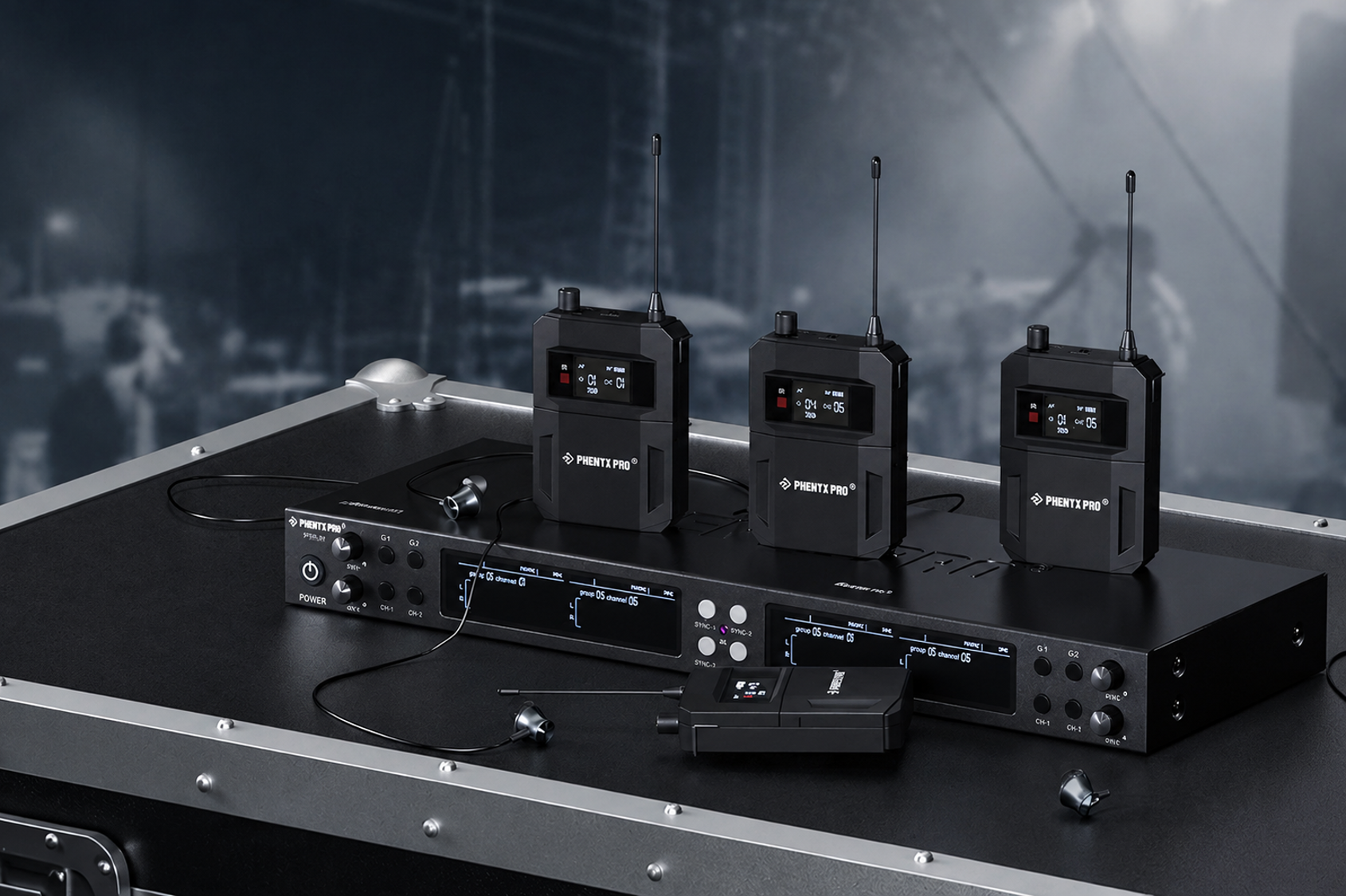
Pare de perder tempo com abas intermináveis de produtos – Encontre seu IEM Mono perfeito em segundos
Compare o PHENYX PRO Série IEM Mono combine a contagem e a configuração da banda, e encontre um sistema IEM sem fio que se encaixe na forma como seu grupo ensaia, se apresenta e monitora no palco.
Learn More
Como Escolher o Sistema de Microfone Sem Fio Phenyx Pro Certo
Sistemas de microfone sem fio permitem que você se mova livremente em qualquer ambiente enquanto mantém qualidade de som excepcional, seja falando em uma reunião corporativa, transmitindo uma mensagem na igreja ou se apresentando no palco. Este guia ajudará você a encontrar o sistema de microfone sem fio Phenyx Pro que melhor atende às suas necessidades, adaptado a diferentes cenários.
Learn More
PAS-225X vs PAS-227X: Escolhendo o Sistema de Antena Certo para Sua Configuração Sem Fio
Configurar um sistema de microfone sem fio ou IEM frequentemente envolve desafios como interferência de sinal, cobertura reduzida e transmissão instável. O splitter PAS-225X e o combinador PAS-227X da Phenyx Pro oferecem soluções dedicadas para as extremidades de recepção e transmissão. Ao melhorar o gerenciamento da antena, esses dispositivos ajudam a garantir sinais mais limpos, melhor cobertura e uma experiência sem fio mais estável no geral.
Learn More